I guess one of my jobs as a pastor is to be looking down the line and prayerfully exploring how we need to shape up to meet the challenges that are coming in the context of mission. Two things converged recently – one by mistake, and one through prayer.
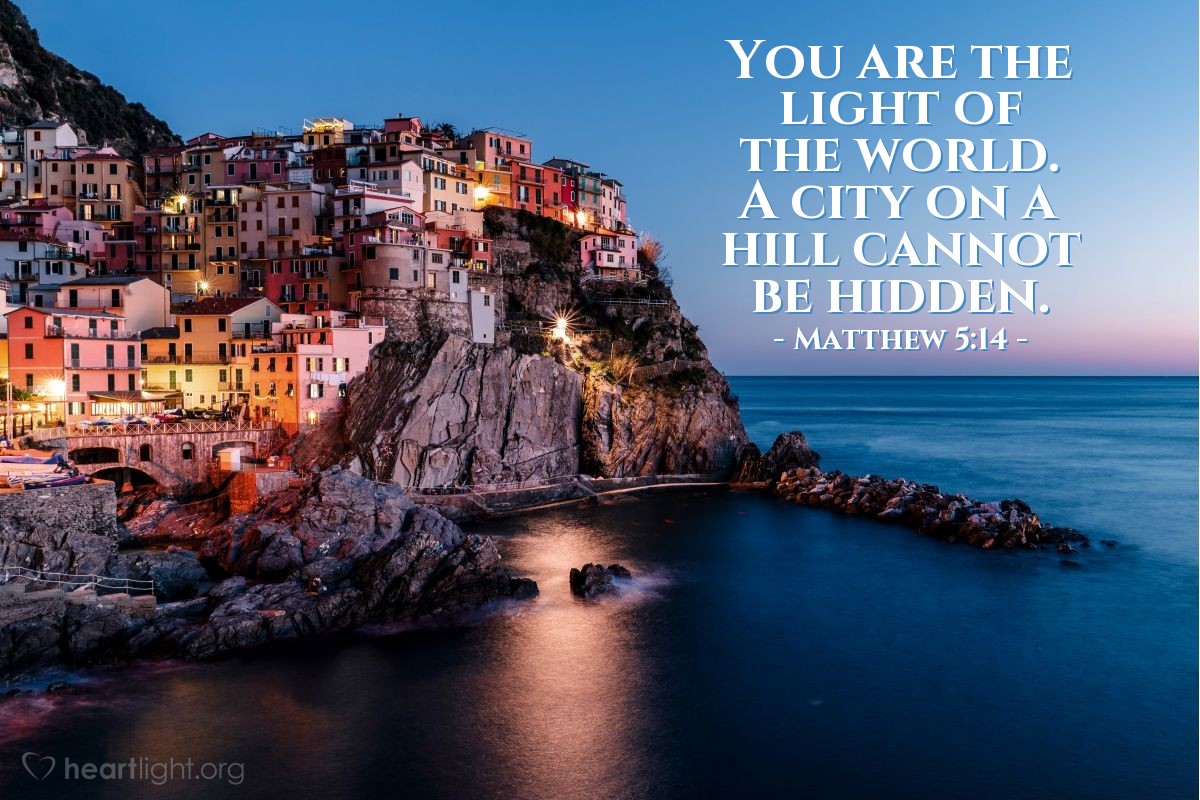
The mistake was announcing that, ‘from next week, we’ll be meeting in the city hall for worship.’ What I meant was that we were meeting in the village hall, but that’s not what came out. Several weeks later, seeking to answer the question, ‘what is God doing on Arran?’, the words of Jesus in Matthew 5: 14 came to mind,
“You are the light of the world. A city set on a hill cannot be hidden.”
In a real sense, whatever God has being doing with us at Arran Baptist Church, in many ways we’ve emerged from under something of a ‘bushel’. The moment those verses came, years of life and study came crashing towards me as I start to piece together what my own personal instincts are about how we live as Christians in the age we are in, especially in an island culture.
In particular, the work of my Masters dissertation came back into focus. I’ll save you the long version, but in short, I was writing in dialogue with a book by a chap called Rod Dreher called ‘The Benedict Option.’ It’s about how, in the ‘Dark Ages’ the Benedictine movement of monasteries kept not only the light of Christ alive in the midst of social decay, but in a sense rescued civilisation. Thomas Cahill suggests that the Irish monastics did the same in their land and beyond, and in my paper, I spoke about the Northumbrian and Scottish monastics and how they also offered a similar but nuanced version of the same thing. To be fair, they were just all about establishing a community of Jesus – the rest came as a consequence of that.
The thrust of the conversation is ‘how can we shine the light of Christ in our age’, especially in the midst of the depths of the cultural moment which is the 2020s.
I confess I wasn’t overly generous to Dreher, partly because there is a certain sense of ‘withdrawal from society’ type attitude in his writing. He’s writing in the American context, and sure, like for us, Christianity is on the back foot, except post-Christendom Europe is further down the line of the decline. Only 6 years ago, I though he was being too reactionary, but I now confess that his vision is much clearer in my view than it was then – pre-covid lockdown, the rise of populism and the new totalitarianism in Western governments, to say nothing of the turgid moral soup which sours as the days go on. Desperate times – divine methods!
Back to reality: I am now convinced that, whilst a utopia cannot be built this side of the return of Christ, the best context for life and faith is the building of a generous and visible Christian community which is, actually, unashamedly generous AND Christian.
Generous – what I mean by that is that Christian community is not a self-preservation society, or some kind of Noah’s ark (yet). It’s still possible to get onboard and we welcome that at every turn. The community that we build should be the most joyous, hopeful, loving, transformative community on the planet precisely because Jesus is at the centre, and because his call to mission permeates all we do. We are in deed generous with the message, but also with our lives. And so, whilst the community of the church needs to be strengthened in significant ways, it doesn’t do it ‘behind monastery walls’, or tucked away for fear of the storm.
Christian – it might seem daft to say that the community we are building needs to be Christian. By that, I don’t just mean that it believes Christian things, but that it LIVES Christianity as discerned by the believers from the pages of scripture and in light of our context. Celtic monasteries were described by Ian Bradley as being ‘Colonies of Heaven’ – small experiments of Kingdom life in the midst of it all that were solid at the core (thoroughly Christian!), but also accessible (generous).
To move beyond the realm of theoretical ideas, what in reality am I talking about? I am talking about being a community that goes beyond an hour on a Sunday morning. People who really do live in community shaped by Christ and the teaching of Christ, and who do so with joy. The idea of the church being a reactionary misery station throwing out truth bombs does not appeal. I believe the absolute visibility of Christian life and witness speaks more truth than an out of context meme tossed out like a hand grenade to take out a few miserable sinners.
I have a sense this idea might become a wee series here as I ‘think out loud’ about this and invite others into the conversation in my context. I also have a sense that, after taking a bit out time out of my doctoral studies due to the radical change in the context of the church here, I may even have something to explore at that level as well as explore on the ground.
So, what does it look like to be a city on a hill?
 Andrew S M Clark