No, no one has moved his beach towel from his favourite sun lounger! He hasn’t been cut up on the exit from the roundabout on the A1 towards Durham. I’m talking about his pectoral cross.
On my recent trip to Durham, this Scot dipped into his pocket and drew out £7.50 sterling for the privilege of visiting the Treasury at Durham Cathedral last week! I have a sense I may have paid a lesser amount many years ago when the ‘treasury’ was in a different place, but I have no real recollection of visiting, and sense that I didn’t really have the same connection to the story of St Cuthbert back then. I do remember there being more flashy communion ware etc. when I visited before, but this time round the collection was very ‘stark’.
On the West side of the Cloisters, the former refectory of the monks at Durham stands, and underneath, the former kitchen which now hosts the most precious items the Cathedral holds. I made my way through the general ‘old bits of stone’, a fine statue of St Cuthbert, and a good few replicas of various things, down the back lift into the Treasury. You could sense you’d stepped into a controlled environment – that ‘museum stillness’ that controlled environments have. The room has a few pieces of haberdashery from the fringes of Cuthbert’s garments, some fragments of his ancient oak coffin, and a couple of other artefacts.
Then I caught sight of it. Suspended in the centre of a glass display case – St Cuthbert’s cross.
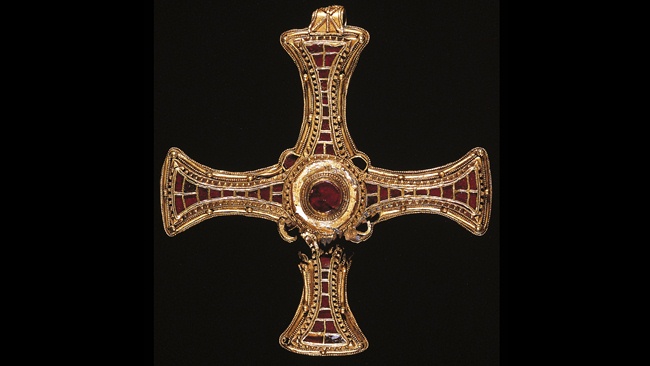
St Cuthbert’s pectoral bishop’s cross was discovered under layers of ecclesiastical vestments covering his remains over 1000 years ago. With him, a beautifully bound portable copy of John’s gospel in Latin. That is a treasure in itself, which can be seen at the British Library by the Lindisfarne Gospels, but I digress. The cross, a small gold cross with equal-length beams, about 10cm x 10cm, is an understated beauty. This cross would fit on your palm. Bearing in mind this would have hung around the neck of a fairly humbly dressed monastic bishop in a reasonably humble community, it would have caught people’s attention. In Cuthbert’s day, bishops were more actively out in the community evangelising – it would have been the Abbot who exercise the rule of the monastery and who would have held more organisational sway back in the day. So, people would have seen this cross on a regular basis…or at the very least, they’d have seen Cuthbert among them.
Now, depending on your perspective, you might wonder what this would communicate. We might make the accusation of ostentation. We might say ‘that gold could have been sold and the money given for the poor’ (before we realise that Judas used similar words about the perfume spread on Jesus’ feet). But ostentation wasn’t the motive of the church in those days. Like the beautifully illuminated Lindisfarne gospels or the similarly created Book of Kells, along with other beautiful items, the intention was to create signs of the beauty, majesty and glory of Christ and his Word for a non-reading population to SEE! The stone ‘high crosses’ carried images of biblical stories as permanently available ‘flannel graph’ in a world where images communicated more than words. In a world where such beauty wasn’t readily seen, there it was, being carried by those who carried the message of Jesus.
Is this not the same as good websites, decent social media, a picture on an AV presentation, worship bands and decent music, paintings, art and every other medium that uses beauty to create a sense of the divine? In a world where people’s attention spans are sapped by social media scrolling, TikTok videos and YouTube Shorts, where universities lament that many of their students can no longer take in required reading in bulk, is the day for the visual upon us again?
Back in the Treasury at Durham Cathedral, I walked around that little pectoral cross a few times taking in its simple beauty, remembering the story of that one faithful, humble servant of Jesus who’d have worn it. A man who had to be begged to take on the role to exercise the ministry of bishop.
I wondered how the church displays the beauty, majesty and rule of Christ in an attractive way in our day. I wondered how little we appeal to all our perceptive senses in the spreading of the gospel, becoming rather word-heavy as if following Jesus was a Bachelors Degree in Theology. I wonder if more people need to see the beauty of a simple cross on our chest before they see us, in every sense of the word. I imagine that we need to paint people pictures, create photographs and beautiful prints, I imagine we need colour, contour, and something that creates awe and points up to God in the the equivalent way that those massive vaulted ceilings do. More than that, I wonder if our active participation in the world with acts of love, mercy, grace alongside courageous proclamation of Jesus, could more effectively contribute to the mosaic of gospel presentation to our 21st century society – if only we begin believing in beauty again.
 Andrew S M Clark