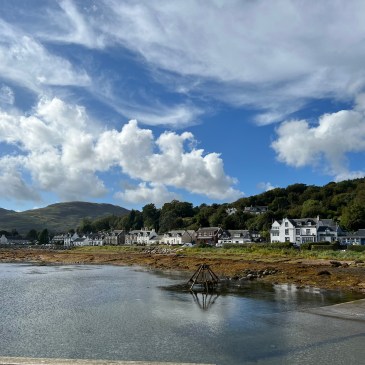
Developing a contextual mission in a post-Christendom landscape
Context and Motivation
As the pastor of Arran Baptist Church with a passion to share the good news of the gospel in our island context, where we had already been seeing positive signs of growth, it seemed important to take the time to reflect deeply on our mission context and on the movements of God amongst our congregation. It was clear to me that, even with the positive signs of growth, we lacked intentional discipleship pathways for both mature and new believers. Additionally, I recognised that as our congregation grew and we moved into a larger meeting space, developing participants in public worship became more challenging in our new circumstances. Other solutions to this than adding more services and programmes were required to develop both discipleship and leaders.
When the opportunity arose to pursue a Doctor of Ministry degree as part of a stream focused on missional theology and ecclesiology, with others focused on movement leadership, this seemed to me the best way to integrate the development of our mission with careful theological and cultural reflection. The short-term, low-resource intervention, consisting of a preaching series and a participatory course, helped us catalyse measurable shifts in theological imagination, develop a shared language, and begin early-stage missional praxis in our setting. Participants developed a shared theological language around discipleship. They moved from a position of near passive participation in gathered worship to a greater embodiment in gathered settings, and of a more active engagement in everyday discipleship. Initially cautious participants became inspired to pursue some early-stage missional practices they may previously have been very concerned about. This is significant for churches in similar contexts, where the challenge is not simply numerical decline but the absence of accessible pathways for forming disciples in everyday life.
Whilst the intervention project was focused on the Arran context, many of the principles will be transferable to comparable islands and rural settings, and further afield as the church seeks to navigate the new cultural context of post-Christendom Scotland.
Post-Christendom Reality in Scotland
Those who serve in Scotland will likely be aware of many challenges facing the church. The recent national story leaves us with many church buildings at the heart of communities, but participation has declined, and their life cannot be sustained. This is true across many denominations. Many city, town and rural churches are closing or selling buildings. Many communities face ageing congregations, with younger generations often absent. This is not only the story of the church: many rural and island communities find that younger people have to move to the mainland’s towns and cities for education or work, and many do not return permanently.
As in many places in Scotland, rural and island communities find the lingering echoes of cultural Christianity, but there can be a weak confidence in the institution. Broader cultural influences associated with our post-Christendom context, such as secularisation, relativism, and consumerism, make it challenging to reimagine the gospel. This is especially true where a lack of spiritual potency in the life of the church has left a vacuum in society for spiritual meaning. We have what might be called a “spiritual supermarket,” where every spirituality is available and often sought out over and above the offerings of the church.
Signs of Hope in Rural and Island Churches
Rural and island communities, however, seem to hold on to deep relational and community networks amid wider societal fragmentation. Proximity to one another and distance from wider population centres create a sense of reliance on one another. There can remain a deep sense of community and place, as well as a long community memory of what has shaped the community through blessing and struggle.
The question for many is not whether God is at work, but how we can make disciples who take full advantage of our context and adapt to rising challenges to create disciples of depth.
Challenges in Rural and Island Contexts
There are, however, challenges particular to rural and island communities. There can be a geographical dispersion of people across several small communities that, in themselves, cannot support an institutional church. There are seasonal rhythms in tourism that affect people’s availability due to seasonal work, and the changes that can come to congregations when visitors appear – the ‘feel’ of a congregation can really shift with significant numbers of visitors in the spring and summer months, especially in tourism hotspots.
Perhaps a more subtle challenge is particularly pertinent for evangelical churches, where the community have a traditional view of what church is, but where a quiet secularisation creates suspicion of a convictional expression of faith.
The implications of these opportunities and challenges are many, but as we reflect on the core mission of the church to make disciples, we must recognise that inherited attractional models of church will be insufficient in and of themselves to continue providing the answers. Small communities can face real limits with volunteer availability, capacity may be fragile, financial and material resources may be limited, and the thought of ‘yet more programmes’ can not only be exhausting but challenging across dispersed communities in rural or island settings. Practical issues like dark, poorly maintained country roads and poor weather can make evening events really difficult, limiting the timeframe when gatherings are possible. Moreover, decades of programme-based growth solutions can foster spectatorship and feed into the materialism of the day, in sharp contrast to a New Testament picture of active, engaged discipleship.
We need discipleship and a way of gathering disciples that is relational, embodied, and integrated into everyday community life, and that takes the seasons’ rhythms seriously. For long-term sustainability, we must ask how we shift from simply attracting attendees to a service that cultivates missional disciples of all ages.
A Simple Discipleship Framework
The intervention project at Arran Baptist Church firstly recognised that we needed a refined understanding of discipleship. We became aware that there were a variety of limits in our understanding of what discipleship was: some equated it simply with the short period of the initiatory process after conversion; some believed disciple-making was about evangelism; others expressed that, from their experience, after a certain point, believers were just left to mature on their own.
We worked together in the early stages to articulate a definition of discipleship, arriving at the following:
Being with Jesus; Becoming like Jesus; Doing what Jesus did.
We arrived here after considering a number of definitions that integrated the relational, transformational, and missional nature of discipleship, to capture all of those. This simplicity was felt to be an adaptive strength as we share a language across the body of the fellowship and a fresh impetus to make this task our focus.
From Programmes to Communities of Practice
Early research from the first stage of the intervention project invited people to reflect on current means of disciple-making within the fellowship’s life. We discovered several strengths:
- a warm, relational atmosphere
- a desire to grow and be faithful to God
- a Sunday gathering with teaching and preaching that was already provoking personal transformation
- a readiness to engage in spiritual discussion before and after Sunday services
- informal relationships growing amidst a strong culture of care and support
Despite this, one common thread emerged: the desire for discipleship pathways and the recognition that the church hasn’t had much experience in this area beyond traditional inherited forms. There was little desire for programmes, but more meaningful opportunities for face-to-face relationship-building, mutual mentoring, and prayerful support.
This discovery added real traction to the project assumptions – that clear disciple-making opportunities needed to emerge. The second stage of the intervention project was the delivery of a six-week course entitled ‘Exploring Missional Discipleship’, with a focus on developing Communities of Practice – an overarching description of the various types and sizes of groups which may best fit our context.
- Discipleship Micro-Groups
Taking note of the expression of interest in smaller, more intimate group settings, discipleship micro-groups of 2–3 were explored. In practice, these groups are flexible and adaptable in island and rural settings, do not require a church building, do not depend on clergy to run, and are easily replicable with no additional resources required. More than this, they create a confidential space where deeper conversations, sharing scripture, prayer, and opportunities for accountability can take place.
2. ‘Ceilidh Church’ – Participatory Gatherings
Secondly, there was a need for small, publicly accessible gatherings held in third spaces, where people could contribute their gifts in a setting that was not daunting, still relational, but less intimate than the 2–3 setup. Inspired by the open, participatory, and multi-voiced gatherings witnessed in 1 Cor 11–14, the connection can be made to the concept of a traditional ceilidh. Although commonly associated only with dancing today, in the recent past and still some areas, these were communal gatherings with multiple contributions, often held in second- or third-space settings (homes or community spaces).
In the same way that Corinth were encouraged to enable a flow of contributions to the gathering, a community ceilidh would see songs, stories, poems, dances, musical items and other contributions. Leadership was present at these gatherings to coordinate contributions but was not dependent on a set leadership structure. The ceilidh provides a helpful metaphor for meeting in this way, especially when considering the life of the Trinity as perichoretic, and the ceilidh leader being the ‘caller’ of the dances.
This innovation does not suggest tartan-clad gatherings with a heavy reliance on cultural forms of music or other appropriations, but rather a cultural format that could clarify a participatory way for the church to be together. To ensure that the biblical element remains participatory, a Discovery method of discussion around a biblical text or theme can be encouraged to seek to both avoid the dominance of individual voices and unhelpful leadership bottlenecks. Again, leadership can gently guide where theological needs are expressed and equip disciples with the skills and discernment they need as they seek to participate in such a gathering.
If this is taking place in a model where guests are likely to explore faith, the group may choose to either start a new group or enter an exploratory, evangelistic phase to address needs or questions. More significantly, there is a chance that enquirers and new believers can begin their lives in a gathering where participation and active discipleship are the norm rather than the exception.
We are not looking for a programmatic creation of formal structures but utilising the insights of relational gathering that will emerge through experimentation and a shared goal of carrying the gospel beyond the gathered church through enabling people to experiment with the right levels of support and encouragement. The project demonstrates that Communities of Practice can emerge in these conditions, even in environments where there was little confidence or sense of a possibility of such things. In this way, Communities of Practice are not introduced as programmes, but emerge as the natural outworking of shared vision, relational commitment, and reproducible practices.
Diversifying Leadership
As already mentioned, rural and island churches can experience a shortage of leaders and a high level of expectation for those who lead. We have to hold against this that the task of leadership is to equip believers for ministry (Eph 4: 12), not to do all the ministry themselves – a paradigm which is in most need of reform post-Christendom. Choosing to focus on active missional discipleship and the emergence of smaller Communities of Practice creates opportunities for new models of leadership to emerge with new levels of ownership and creativity.
Depth Before Growth
In communities where numbers can remain small, despite success, we must find new indicators for growth. Arran Baptist Church has seen numerical growth, but we must also translate that growth into meaningful spiritual formation. The question of whether we are forming resilient disciples is one key indicator of growth.
Another indicator is the number of relationships that are being formed with individuals outside the life of the church. Focusing on a small number of those who desire to be discipled and equipped, such as those willing to commit to the intervention project, can create a deeper impact on the community, helping disciples move from a learned helplessness in sharing life and faith to a deeper confidence that not only does our communication of the gospel matter, but that ordinary life lived in plain view is of significance.
Two Practical Commitments
Through the study and project intervention, two key initial commitments have emerged:
- Intentional Discipleship Pathways
The church will aim to engage in wider discussion and exploration of discipleship pathways that equip believers, especially through the Communities of Practice models explored. These do not need to be overly structured frameworks, but rather organic opportunities that arise through nurturing our shared vision, strengthening our relationships, and building confidence in reproducible practices.
- Mission as Shared Practice
- In response to what has emerged in the course intervention, we need to explore ways that evangelism and mission can be rooted in hospitality and faithful presence in the life of the community.
- We will need to emphasise missional rhythms as part of everyday life over programmatic or event-driven programmes.
- We will need to find ways to integrate individual and corporate life more deeply into our community.
- The church will have discussions to pioneer at least one ‘Ceilidh Church’ in the future.
Final Encouragement
Rural and island ministry in post-Christendom requires courage to step out and tell a different story of the place of the church, and the gospel, in society, but also to represent the gospel having built relational trust, humble listening, and with the power and discernment that comes from the Spirit of the missional God.
The early church grew internally through shared discipleship practices (Acts 2: 43 –47), but in number through emboldened witness rather than institutional privilege for its first 300 or so years. Future growth and development of the church post-Christendom will depend less on programmes and more on deep, relational discipleship in a culture that is increasingly suspicious of institutions. The task is to cultivate disciples where God has placed us in ways that are sustainable through an age of cultural upheaval and reimagining for the church in Scotland.
- Cultivate a shared understanding of discipleship and missional language across your ministry setting. This project demonstrated that developing a shared understanding of discipleship was essential for fostering greater mission-focused imagination and aligning the church’s task.
- Build on relationships rather than on programmes, seeking greater sustainability through the depth of those relationships rather than on programmatic responses. Participation throughout the intervention enabled participants to imagine ways they could participate in environments that align with their personalities and perceived levels of competence through their one-to-one interactions in church and in wider life.
- Create practice opportunities. Having the opportunity to practice in trusted environments enables participants to move from a conceptual understanding to a lived expression in a short timeframe.
- Talk about identity, not just activity. Our intervention showed that shifts in practice depend on shifts in identity. People need to develop an understanding that disciple-making is for them, and that it is as much about who they are as what they do.
- Reframe leadership model that equips and releases, whilst faithfully bringing pastoral and theological gifts to the community in the shared life of the community. Our findings indicated a growing openness to a distributed, participatory model of gathering for worship and exploring new relational forms of outreach into the community. This is so crucial in overcoming the post-Christendom ‘leadership bottleneck’.
- Engage cultural forms that resonate. Using modes of meeting rooted in culture (e.g., the Ceilidh shows clear ways of modelling what a multi-participatory gathering looks like, and, if utilised, can form ecclesial forms or missional communities that can begin to flourish in ways that release them from inherited Christendom models).
If you have any questions or if you would be interesting in Andrew exploring the missional challenge in your own context with your own congregation, please do get in touch.
 Andrew S M Clark